
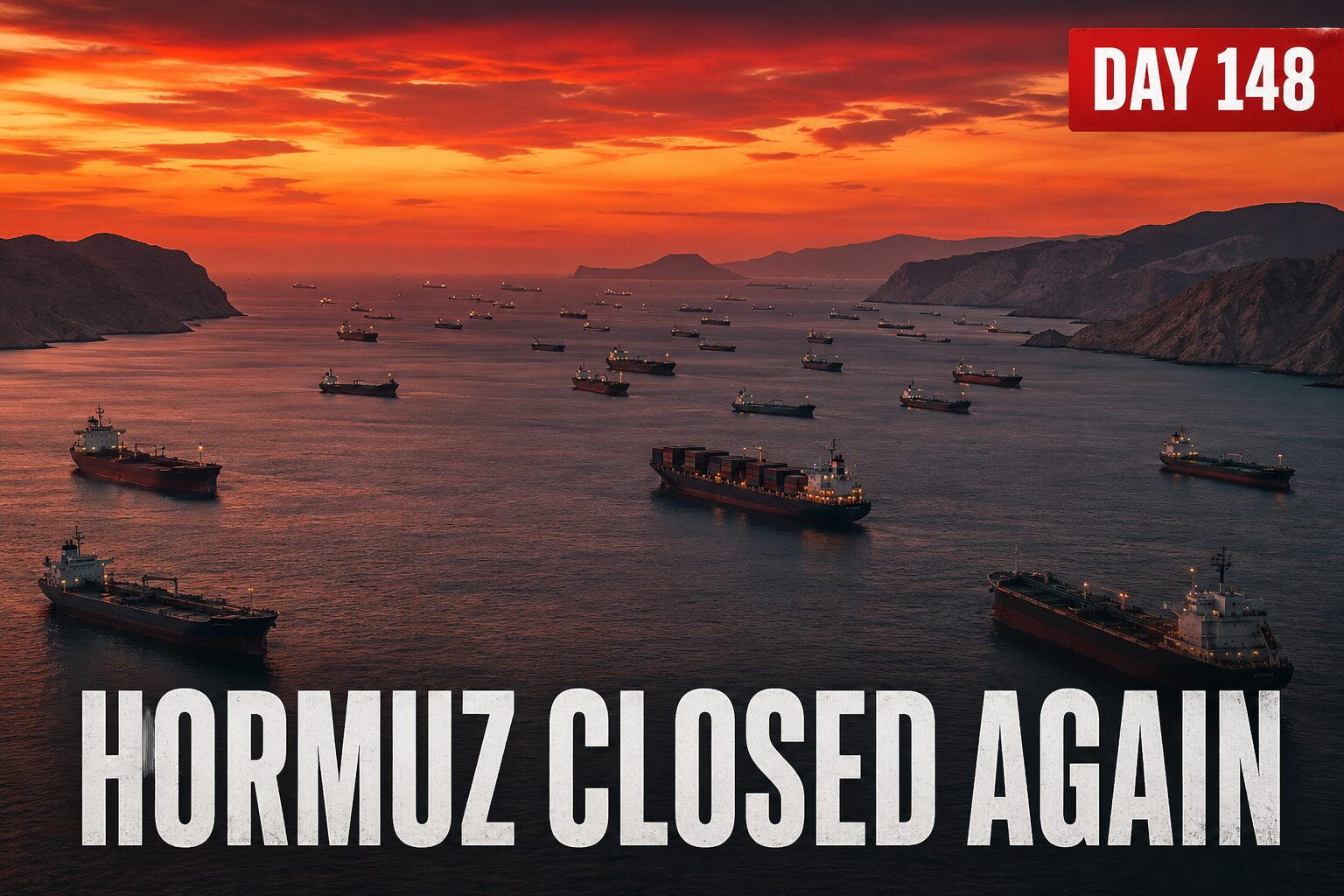
The Strait of Hormuz closed again in mid-July 2026, six weeks after the shipping world thought this crisis was over. A US–Iran memorandum signed in mid-June had set out an agreement in principle to reopen the strait, the US wound down its blockade, and Iran committed to letting vessels pass toll-free during a 60-day negotiation window. Booking desks across Dubai started planning for a normal Q3.
That window has closed. As of late July 2026, the Strait of Hormuz closed to normal commercial traffic once again — day 148 of a disruption that began in late February — and container rates on the major lanes are climbing again rather than settling. If you are an exporter in Jebel Ali, an importer bringing goods in from Asia, or a trader running re-export volume through the UAE, the plan you built in June needs rewriting.
This guide gives you the honest picture: what is actually happening in the strait right now, what it has done to rates and transit times, and the seven practical moves that protect your margin while the situation stays unresolved. No panic, no spin — just what we are seeing on live bookings.
🚨 Cargo stuck or rates jumping on your lane?
Our Dubai desk is rerouting shipments daily. Get a live, all-in quote with current war-risk and surcharge figures included — not a headline rate that changes at booking.
Is the Strait of Hormuz Closed Right Now? (Late July 2026)
The short answer: technically contested, practically closed. Iran’s position is that the strait is shut to any vessel that has not obtained Iranian permission, and it has struck ships that transited without it. The US maintains that the southern lane remains open and has signalled it will reinstate its blockade of Iran-linked vessels. Between those two positions sits an owner deciding whether to risk a hull.
Here is how the year has unfolded:
- Late February 2026 — the strait becomes an active conflict zone; commercial transits collapse.
- Mid-June 2026 — US–Iran memorandum signed; agreement in principle to reopen, blockade wound down, 60-day toll-free passage window opens.
- Late June 2026 — the reopening stalls. Traffic never recovers past a fraction of normal, and rates rise instead of falling. We covered this in our Strait of Hormuz freight rates update.
- 14 July 2026 — closure conditions formally return. Oil moves roughly 10% higher within days; bunker costs follow.
- 19 July 2026 — just 15 vessels transit the strait, against a pre-crisis baseline of around 88 per day. That is roughly 17% of normal throughput.
- Late July 2026 — approximately 453 vessels sit anchored or stopped in the region waiting on a decision.
Two numbers tell you how the market is pricing the risk. War-risk insurance for a supertanker passage now runs near $2.5 million, roughly eight times pre-crisis levels. And prediction markets have put the odds of the strait returning to normal by 1 August 2026 at around 1%.
One caveat worth knowing: in the past 24 hours of reporting, 92 tankers switched off their AIS transponders. Actual movement through the strait is almost certainly higher than the official count — but going dark is not an option available to container lines running scheduled services, which is why box freight is feeling this harder than tanker trades.
Why Freight Rates Are Rising Again — Not Falling
This is the part that catches shippers out. A reopening was announced, so rates should have come down. They did the opposite, for three reasons: capacity is still absorbed by the long way round, war-risk premiums have not unwound, and carriers used the uncertainty to push general rate increases into a peak season.
Indicative container rates as of the mid-July market updates:
| Trade Lane | Rate per FEU | Recent Movement |
|---|---|---|
| Asia → North Europe | ~$5,800 | +$3,000 in six weeks (+8% w/w) |
| Asia → Mediterranean | ~$7,200 | Elevated, Red Sea routing dependent |
| Transpacific → US West Coast | ~$7,500 | +$4,000 since May (+13% w/w) |
| Transpacific → US East Coast | $9,000+ | +6% w/w |
On top of the headline number, war-risk surcharges, bunker adjustments and port congestion fees can add $3,000 to $6,000 per container on affected lanes. Carriers also pushed mid-month increases of as much as $1,000/FEU. When you compare quotes, compare the landed all-in figure — a low base rate with four open-ended surcharges attached is not a cheap booking.
There is one piece of good news, and it matters if you buy from Asia.
What It Actually Costs Into Jebel Ali Right Now
Despite the noise on long-haul lanes, China to UAE has been comparatively stable. July rates into Jebel Ali and Dubai Port held roughly flat month-on-month:
- 20ft container (20GP): approximately $3,294 – $4,086
- 40ft container (40GP): approximately $4,688 – $6,563
That stability is real but conditional. Hormuz-linked surcharges can be applied mid-month, so a rate quoted on the 1st is not necessarily the rate you pay on the 20th. Always get your quote confirmed at the point of booking, in writing, with the surcharge schedule attached. For a fuller breakdown of what drives UAE container pricing, see our container shipping cost guide and our seven ways to cut shipping costs from Dubai.
There is also a demand signal worth watching: August arrivals are projected to fall around 10% month-on-month, suggesting peak season may be easing earlier than carriers planned. If that holds, some of the current rate strength is more fragile than it looks — which is an argument against locking long contracts at today’s peak.
Transit Times and the Long Way Round
Rerouting is the single biggest driver of delay right now. Where services have shifted away from the direct corridor, plan for meaningful additions to your standard schedule:
- Gulf to North Europe: standard schedules stretch significantly where Cape of Good Hope routing applies — budget an extra 10–14 days over the direct transit.
- Gulf to US: East Coast services carry the heaviest rerouting penalty and the widest schedule variance.
- Intra-Gulf and regional feeder: the most reliable option in the current market, which is why feeder capacity is tight. Our Dubai feeder operators guide explains how to use it to beat congestion.
- Dubai to Saudi Arabia: road freight is currently outperforming sea on both cost and reliability for many shippers. See the road vs sea comparison.
Treat every published schedule as an estimate. Blank sailings, port omissions and last-minute rotation changes are running well above normal, and a vessel that arrives on time may still wait for a berth.
Insurance, War Risk and Documentation
The paperwork burden has grown alongside the risk. Before you book, confirm the following:
- Cargo insurance scope — check whether your policy excludes war and strikes risk in the Gulf. Many standard policies now carve out the region or price it separately. Do not assume you are covered.
- War-risk surcharge terms — ask whether the quoted surcharge is fixed for your booking or subject to revision before loading.
- Incoterms exposure — under CIF or DDP the seller carries the surcharge risk; under FOB the buyer absorbs it. In a volatile market this single choice can swing thousands of dollars.
- Standard documentation — commercial invoice, packing list, bill of lading, certificate of origin, and any product-specific certificates. Our Dubai customs clearance guide covers the full checklist and the common causes of hold-ups.
- Force majeure wording — review what your carrier contract permits them to do if the strait situation escalates further.
7 Moves to Protect Your Cargo and Your Margin
- Stop quoting on headline rates. Price every shipment all-in, including war risk, BAF and congestion. A $3,000–$6,000 per-box surcharge stack will erase a thin margin without ever appearing in the base quote.
- Book earlier than feels necessary. With rerouting and blank sailings, the buffer that used to be a week is now closer to three. Late bookings pay premium spot rates.
- Do not lock long contracts at this peak. With August arrivals projected down 10% month-on-month, signing a 12-month rate at July levels is a real risk. Prefer shorter terms or index-linked pricing.
- Split high-value and urgent cargo to air. When ocean transit is unpredictable and rates are elevated, the air premium narrows. Our sea vs air comparison shows where the crossover sits.
- Use the UAE as a buffer, not just a transit point. Holding stock in a Dubai free zone and releasing regionally is often cheaper than repeated long-haul shipments at current rates.
- Consolidate into FCL where volumes allow. LCL carries surcharges on a per-CBM basis, which compounds fast in a high-surcharge market. Our FCL vs LCL guide covers the break-even point.
- Work with a forwarder holding real allocation. In a tight market, space beats price. A partner with committed slots will move your cargo when a cheaper quote leaves it rolled at the terminal for three weeks.
Strait of Hormuz Closed — Frequently Asked Questions
Is the Strait of Hormuz closed right now?
Yes. For practical purposes the Strait of Hormuz closed again on 14 July 2026. Iran considers it shut to vessels without its permission and has struck non-compliant ships, while the US says the southern lane is open. On 19 July only 15 vessels transited against a normal baseline of around 88 per day. Treat it as closed when planning.
Did it not reopen in June 2026?
An agreement in principle was signed in mid-June and a 60-day toll-free passage window opened, but traffic never meaningfully recovered and closure conditions returned on 14 July. Our reopening analysis tracked that attempt from the start.
When will freight rates come back down?
Nobody credible is giving a date. Even after a stable agreement, industry estimates put full normalisation at four to six months, because capacity has to unwind from long routings and insurance markets reprice slowly. Prediction markets currently price only a 1% chance of normal transit by 1 August 2026.
Should I delay my shipment and wait for cheaper rates?
Generally no. Waiting has cost shippers more than it saved this year — every time a reopening looked likely, rates rose instead. Ship what you need, buffer your timelines, and avoid committing to long-term contracts at peak pricing.
Are shipments into Dubai and Jebel Ali still moving normally?
Yes. Jebel Ali is operating, and China to UAE rates held roughly flat through July. Regional feeder and road freight are the most reliable options in the current market. The disruption bites hardest on long-haul services routed through or around the affected corridor.
Plan your next shipment with people watching this daily.
Vortex Shipping moves ocean, air, land and project cargo through Dubai across the Middle East, Asia, Europe and the Americas. We will tell you honestly what your lane looks like this week — including when the answer is wait or reroute.
Request a Free Quote → WhatsApp Us
Or call us direct: +971 56 133 4760 · +971 54 231 0203
Email: trade@vortexshipping.ae · Office 1914, The Binary by Omniyat, Business Bay, Dubai
Related Guides
- UAE Shipping Crisis 2026: Essential Guide to Survive Surging Freight Rates
- Strait of Hormuz Freight Rates 2026: Critical Update as Reopening Stalls
- Shipping from Dubai to Europe: 2026 Cost, Transit Time & Best Freight Option
- Shipping from Dubai to USA: 2026 Cost, Transit Time & Best Shipping Method
- Our Full Range of Freight Services
Sources
- Freightos — Hormuz closure pushing fuel costs back up, 14 July 2026 update
- Straits.live — Strait of Hormuz live transit tracker
- Freightos — Ocean freight impacts: Hormuz status update and analysis
- Sino Shipping — Freight shipping from China to UAE, July 2026 update
Rates and status figures in this article reflect market reporting available as of 27 July 2026, with the Strait of Hormuz closed to routine commercial transit. The situation is changing week to week — contact us for a live quote before making a booking decision.
2 comments on “Strait of Hormuz Closed Again: UAE Freight Rates August 2026 & 7 Moves to Protect Your Cargo”