
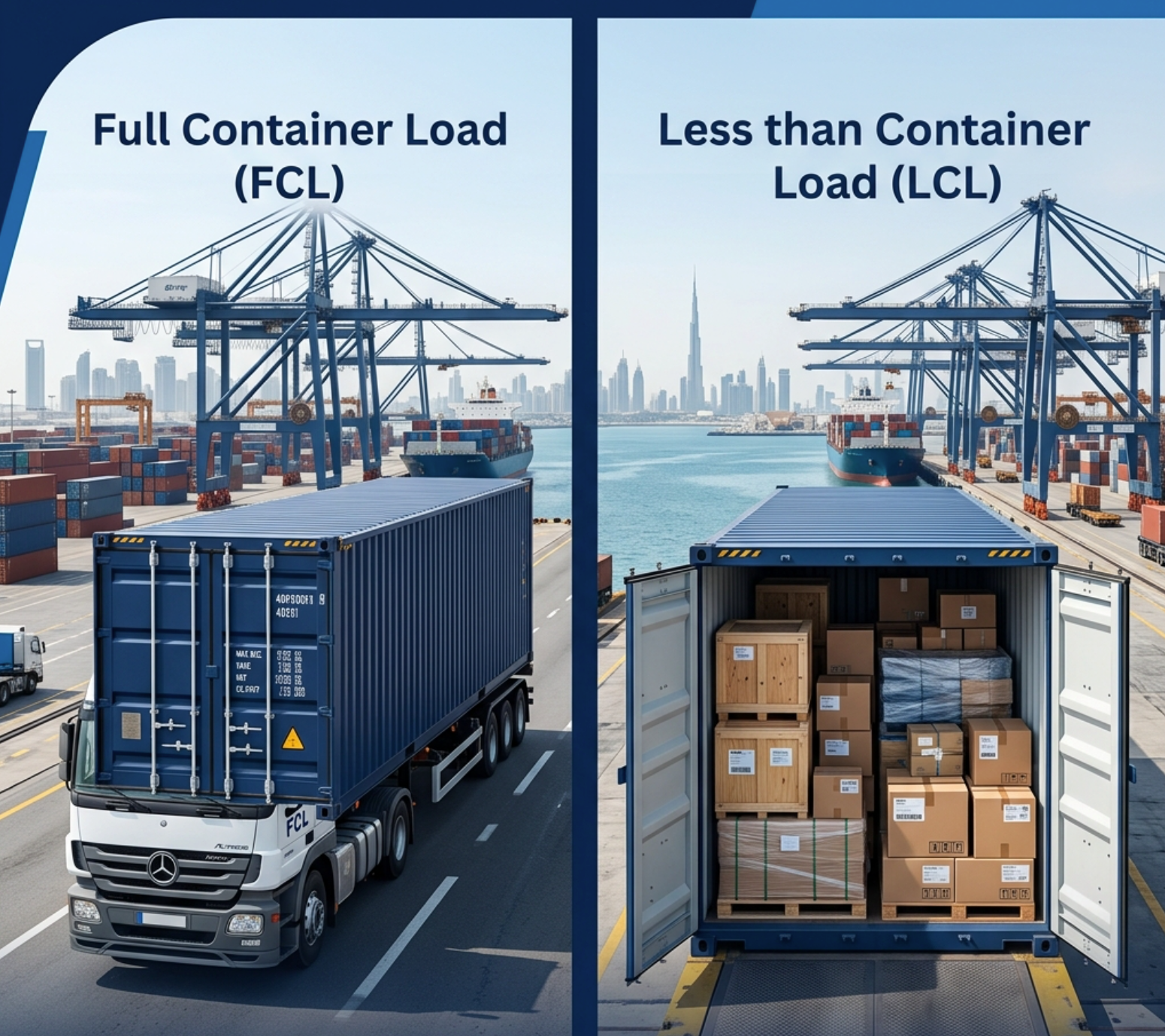
FCL vs LCL shipping in Dubai — choosing wrong between these two options can cost your business thousands of dirhams on every single shipment. With Jebel Ali Port processing over 15.6 million TEUs annually, Dubai businesses ship massive volumes using both methods every day.
Yet many importers and exporters default to the same container type without analysing whether it is actually the most cost-effective choice. The result? Overpaying for empty space or splitting cargo unnecessarily.
This guide breaks down 5 essential tips to help you choose between FCL and LCL confidently — with real cost comparisons, a break-even calculator, and expert insights for 2026.
1. What is FCL and LCL? A Quick Breakdown
Before diving into costs, let us clarify exactly what each option means:
FCL (Full Container Load) means you book an entire container exclusively for your cargo. Whether you fill it completely or not, you pay one flat rate for the whole box.
LCL (Less than Container Load) means your cargo shares container space with shipments from other businesses. You only pay for the cubic metres (CBM) your goods actually occupy.
Container Sizes Available from Dubai
| Container Type | Internal Dimensions | Max Cargo Weight | Volume Capacity |
|---|---|---|---|
| 20ft Standard | 5.9m × 2.35m × 2.39m | 21,770 kg | 33 CBM |
| 40ft Standard | 12m × 2.35m × 2.39m | 26,680 kg | 67 CBM |
| 40ft High Cube | 12m × 2.35m × 2.69m | 26,460 kg | 76 CBM |
2. FCL vs LCL Shipping in Dubai: Full Cost Comparison
Here are the typical rates when shipping from Jebel Ali Port in 2026:
Ocean Freight Rates (Estimated)
| Route | FCL 20ft | FCL 40ft | LCL (per CBM) |
|---|---|---|---|
| Dubai → Mumbai | USD 350–550 | USD 550–850 | USD 40–70 |
| Dubai → Singapore | USD 600–900 | USD 900–1,400 | USD 50–85 |
| Dubai → Rotterdam | USD 1,200–2,000 | USD 1,800–3,200 | USD 60–90 |
| Dubai → Mombasa | USD 800–1,200 | USD 1,200–1,900 | USD 55–80 |
Transit Time Comparison
| Route | FCL Transit | LCL Transit | Difference |
|---|---|---|---|
| Dubai → Mumbai | 3–5 days | 7–12 days | +4–7 days |
| Dubai → Singapore | 7–10 days | 12–18 days | +5–8 days |
| Dubai → Rotterdam | 18–22 days | 25–35 days | +7–13 days |
| Dubai → Mombasa | 7–10 days | 14–20 days | +7–10 days |
LCL takes longer because of consolidation at origin (combining multiple shippers’ cargo) and deconsolidation at destination (separating them).
3. The 15 CBM Break-Even Rule
The industry standard break-even point for FCL vs LCL shipping in Dubai is approximately 15 CBM. Here is how the maths works:
Cost Calculation Example (Dubai → Mumbai)
| Cargo Volume | LCL Cost (at USD 55/CBM) | FCL 20ft Cost | Winner |
|---|---|---|---|
| 5 CBM | USD 275 | USD 450 | 🟢 LCL saves USD 175 |
| 10 CBM | USD 550 | USD 450 | 🟢 FCL saves USD 100 |
| 15 CBM | USD 825 | USD 450 | 🟢 FCL saves USD 375 |
| 25 CBM | USD 1,375 | USD 450 | 🟢 FCL saves USD 925 |
Key insight: Once your cargo exceeds 8–10 CBM on most Dubai trade lanes, FCL almost always becomes the cheaper option. The traditional “15 CBM rule” is actually conservative — you start saving with FCL much earlier.
But volume is not the only factor. Read the tips below before deciding.
4. Advantages and Disadvantages Compared
FCL Advantages ✅
- Faster transit — no consolidation delays, 3–7 days faster
- Lower damage risk — container sealed at origin, opened at destination
- Simpler customs — handled as one unit, fewer inspection triggers
- Predictable costs — flat rate regardless of volume within the container
- Priority handling — FCL gets faster port processing at Jebel Ali
FCL Disadvantages ❌
- Higher upfront cost if cargo volume is low
- Wasted space if container is not fully utilised
- Minimum commitment of one full container
LCL Advantages ✅
- Pay only for space used — ideal for small volumes under 8 CBM
- Flexibility — ship small batches frequently instead of one large shipment
- Lower capital requirement — perfect for startups and SMEs testing new markets
- No minimum volume — ship even 1 CBM
LCL Disadvantages ❌
- Slower transit — consolidation and deconsolidation add 5–10 days
- Higher damage risk — more handling points means more chances for breakage
- Hidden fees — warehouse handling, deconsolidation charges, destination THC
- Delay risk — if another shipper’s cargo has customs issues, your goods may be held too
📹 Video: FCL vs LCL — Which Should You Choose?
5. 5 Essential Tips for FCL vs LCL Shipping in Dubai
Tip 1: Calculate Total Landed Cost, Not Just Freight
LCL quotes look cheaper on paper. But they often exclude:
- Consolidation fee (USD 30–60)
- Deconsolidation fee (USD 30–50)
- Destination terminal handling (USD 80–150)
- Warehouse handling charges
Always ask your freight forwarder for a complete door-to-door quote, not just the ocean freight rate.
Tip 2: Consider Your Cargo Type
Fragile, high-value, or temperature-sensitive goods benefit from FCL because the container stays sealed throughout. LCL means your cargo gets loaded and unloaded alongside other shippers’ goods — increasing handling risk.
Tip 3: Factor in Time Cost
LCL adds 5–10 days to your delivery. If your goods are seasonal, perishable, or your buyer has a deadline, those extra days carry a real cost that does not appear on the freight invoice.
Tip 4: Batch Small Shipments Into FCL
Instead of sending three LCL shipments per month, can you batch them into one FCL every 6 weeks? This approach often saves 30–40% on total freight spend while reducing damage risk.
At Vortex Shipping, we help businesses analyse their shipping patterns and identify the optimal batching strategy.
Tip 5: Get Expert Advice for Borderline Volumes
When your cargo sits between 8–15 CBM, the choice is not straightforward. Variables like destination port, cargo weight, seasonal surcharges, and customs clearance complexity all influence which option saves more money.
Do not guess — ask your freight forwarder to run both calculations side by side.
Quick Decision Checklist
| Question | If Yes → | If No → |
|---|---|---|
| Is your cargo over 10 CBM? | FCL | Consider LCL |
| Is your cargo fragile or high-value? | FCL | Either option |
| Do you need delivery within 7 days? | FCL | LCL is acceptable |
| Are you testing a new market? | LCL | FCL for established routes |
| Is your budget extremely tight? | LCL (for under 8 CBM) | FCL for larger volumes |
Let Us Help You Choose the Right Option
Every shipment is different. The right choice between FCL and LCL depends on your specific cargo, route, timeline, and budget. Making the wrong call costs you money on every single consignment.
Vortex Shipping analyses your shipping requirements and recommends the most cost-effective solution — whether that is FCL, LCL, or a hybrid approach that maximises your savings.
Get a Free FCL vs LCL Cost Comparison
Request a free quote and we will calculate both options for your exact shipment:
- Phone: +971 54 231 0203 | +971 56 133 4760
- Email:
- Office: Empire Heights Building A, Business Bay, Dubai
About the Author
Vortex Shipping Team — Based in Business Bay, Dubai, Vortex Shipping is a leading freight forwarding and feeder operator offering both FCL and LCL ocean freight services. We help businesses choose the most cost-effective shipping method for every shipment across the UAE and beyond.
Need a rate for this lane?
Message our Dubai desk on WhatsApp with the route and the cargo. We reply the same working day — and we will say plainly if the lane is not workable right now.