
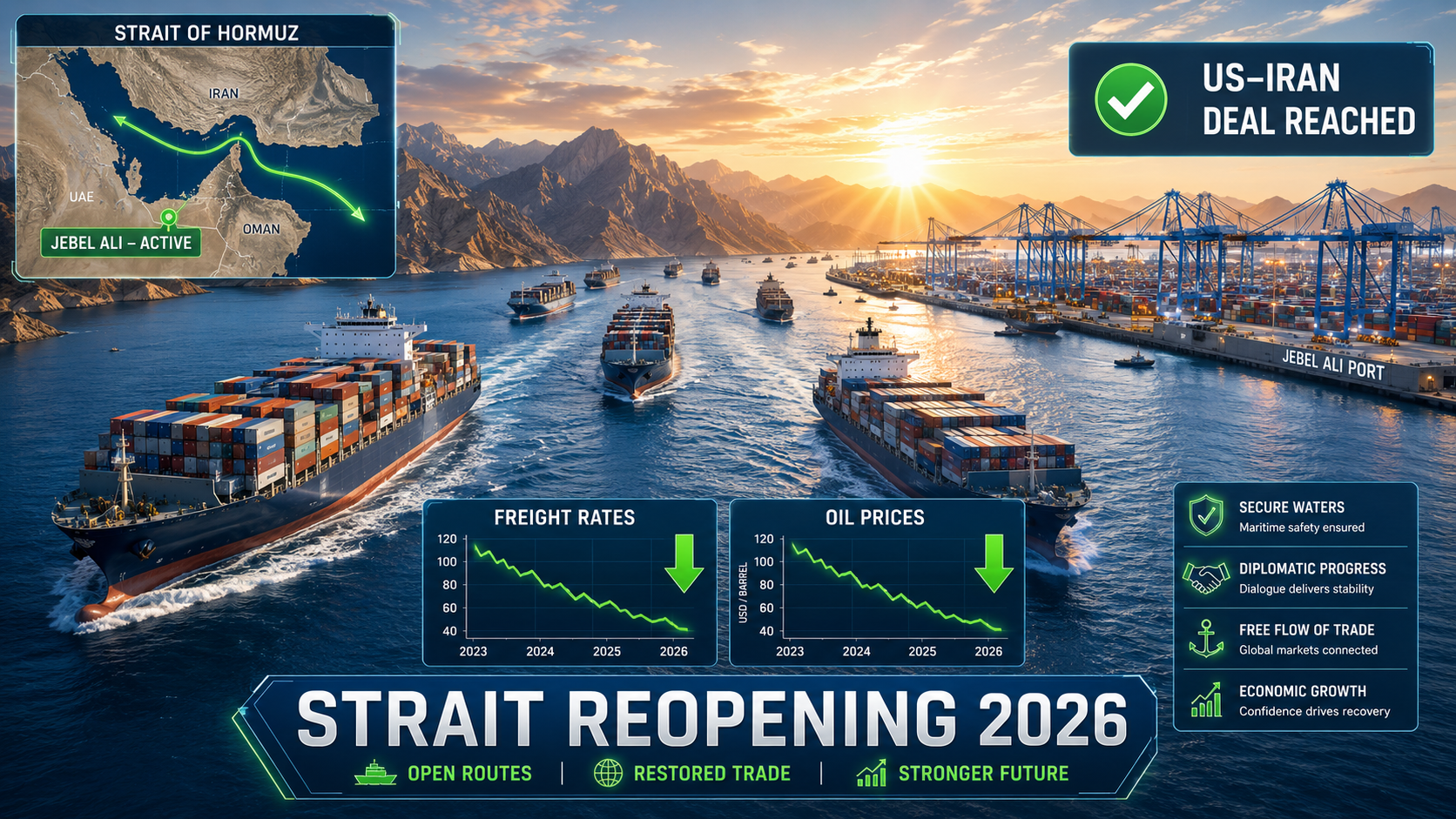
👉 Read the latest: Strait of Hormuz Freight Rates 2026: Critical UpdateStrait of Hormuz reopening 2026 is the news every UAE importer and exporter has been waiting for. After more than three months of disruption, the United States and Iran reached an interim peace agreement in mid-June 2026, clearing the way for the world’s most important oil-and-cargo chokepoint to reopen to commercial shipping. The formal signing is scheduled for 19 June in Switzerland, oil prices have already fallen, and vessel traffic toward Jebel Ali is beginning to recover.
But here is the part most headlines are getting wrong: the strait is reopening in phases, not overnight. If you ship through the UAE, the next few weeks are the most important window of the entire crisis — the moment to rebook held cargo, lock in falling rates before everyone else does, and rebuild your supply chain on the right side of the recovery. This Strait of Hormuz reopening 2026 guide from Vortex Shipping gives you the verified facts and a clear action plan.
Quick context: This is the follow-up to our widely-read UAE Shipping Crisis 2026 guide. If you want the full background on how the crisis began and why rates spiked, start there — then come back here for the recovery playbook.
Strait of Hormuz Reopening 2026: What Actually Happened
The Strait of Hormuz had been effectively closed to commercial traffic since 28 February 2026, when the regional conflict between Iran, the United States and Israel escalated and Iran restricted passage through the waterway. Roughly 20% of the world’s seaborne oil and a huge share of Gulf container traffic normally flow through this 21-mile-wide passage, so its closure triggered one of the worst logistics shocks the Middle East has seen in decades.
The Strait of Hormuz reopening 2026 began to take shape in mid-June:
- On 14 June, both sides announced that a peace deal had been reached, declaring an end to military operations.
- The agreement includes authorisation to lift the US naval blockade and reopen Hormuz to international shipping.
- A formal signing is scheduled for 19 June in Switzerland, covering the technical steps — most importantly sea-mine clearance — needed to physically restore safe navigation. The agreement was confirmed in reporting by Bloomberg.
- A follow-on 60-day negotiation period was agreed for the remaining longer-term issues.
This is a genuine breakthrough. It is also why understanding the sequence of the Strait of Hormuz reopening 2026 matters so much for anyone with cargo to move.
Is the Strait of Hormuz Open Right Now? (The Honest Answer)
Here is the honest status of the Strait of Hormuz reopening 2026 as of mid-June: not fully open yet. A signature reopens the strait politically, but it does not move a ship by itself. Commercial transits through Hormuz were still running at a tiny fraction of normal volume — a couple of vessels per day against a pre-crisis baseline of roughly 94 per day, according to transit data tracked by the International Maritime Organization (IMO).
Before traffic returns to normal, three things have to happen:
- Mine clearance. Naval mines laid during the crisis must be located and removed before carriers and their insurers will sign off on routine transits. This is the single biggest physical bottleneck.
- War-risk insurance normalisation. War-risk premiums spiked to many times their pre-crisis level. Underwriters will lower them gradually as the ceasefire holds and the strait is verified safe — not the moment the deal is signed.
- Carrier confidence and vessel repositioning. Major lines (Maersk, MSC, CMA CGM, Hapag-Lloyd, COSCO and others) pulled tonnage out of the Gulf. Restoring full schedules means physically repositioning ships and re-establishing services, which takes weeks.
Bottom line: the Strait of Hormuz reopening 2026 is real and the direction is unmistakably positive — rates are coming down — but expect a phased recovery over the coming weeks, not an instant return to February’s normal. Businesses that plan around the phasing will save the most and avoid the next round of congestion.
Oil Prices Are Already Falling After the Strait of Hormuz Reopening
One of the fastest market reactions to the Strait of Hormuz reopening 2026 was in energy prices. Brent crude, which had surged above $100 a barrel during the closure, slid back toward the low-to-mid $80s on the news, while regional equities and bonds rallied. Lower oil prices feed directly into bunker (fuel) costs for shipping lines, which is one of the reasons freight rates are expected to ease alongside the fall in war-risk surcharges.
For importers and exporters, this is the early signal that the cost structure of UAE shipping is resetting downward — but the timing of when those savings actually reach your invoice depends heavily on which carrier, route and booking window you use.
Jebel Ali Port & DP World: Recovery, Not Reopening
A common misconception worth clearing up: Jebel Ali Port never shut down during the crisis. Aside from a brief precautionary pause at the very start, DP World kept Jebel Ali fully operational throughout, with no infrastructure damage. As DP World’s GCC leadership explained to Gulf News, what changed was demand-side: vessel calls and new bookings thinned out as carriers avoided the Gulf, and DP World leaned on alternative corridors — bonded trucking from Khorfakkan, Fujairah and Sohar, and emergency land routes — to keep cargo flowing.
With the Strait of Hormuz reopening 2026 now underway, the story flips: inbound vessel traffic to Jebel Ali is set to recover as lines restore Gulf services. That recovery will not be perfectly smooth — expect a period of catch-up congestion as the backlog of delayed and stranded cargo clears and empty containers are repositioned. Early, well-planned bookings will move ahead of that wave.
The Dubai Dh1 Billion Business Support Package — and Why It Still Matters for Importers
Earlier in the crisis, Sheikh Hamdan bin Mohammed, Crown Prince of Dubai, approved a Dh1 billion (about $272 million) support package for Dubai’s business sector, rolled out from 1 April 2026 as a three-to-six-month stimulus, as reported by The National. It is not a “half-price” scheme — it is a set of liquidity-relief measures, and one of them is especially valuable for anyone in trade:
- Customs grace period extended from 30 to 90 days (extendable) — giving importers and exporters far more breathing room on customs data and clearance timelines.
- Three-month deferral of a group of government fees to ease company cash flow.
- Deferral of hotel sales fees and the tourism dirham to support hospitality and tourism.
- Streamlined residency issuance and renewal procedures.
For a trading business rebuilding its supply chain after the disruption, that extended 90-day customs window is a genuine cash-flow advantage — and exactly the kind of detail a good freight and customs partner will help you use to your benefit. See our services for customs clearance support.
What Smart UAE Businesses Should Do Right Now — The Recovery Playbook
The Strait of Hormuz reopening 2026 window is short and competitive. Here is what experienced importers and exporters are doing this week:
- Rebook held and stranded cargo first. If you have containers offloaded at Salalah, Sohar, Khorfakkan or Indian ports under end-of-voyage clauses, arrange onward movement now — before the rebooking rush peaks.
- Lock in rates on the way down. Freight and war-risk surcharges are easing, but they will not bottom out evenly across carriers. The businesses that secure space during the early phase capture the savings first.
- Plan for catch-up congestion. Build a short buffer (days, not the weeks you needed during the crisis) into delivery promises while the backlog at Jebel Ali clears.
- Re-evaluate your routing. Direct Gulf services will return in stages. A blended approach — direct sailings where reliable, with Khorfakkan/Sohar fallbacks — keeps you flexible during the transition.
- Review your insurance again. As war-risk premiums fall, make sure you are not still paying crisis-era rates, and confirm your cover matches your new routing.
- Use the Dh1bn package benefits. Apply the extended 90-day customs grace period and fee deferrals to ease the cash-flow squeeze from the last three months.
- Work with a partner who has live carrier intelligence. Conditions are changing day by day during the Strait of Hormuz reopening 2026. A Dubai-based forwarder with direct carrier relationships can tell you which lines are accepting Gulf bookings and at what rate — today, not last week.
Strait of Hormuz Reopening 2026 — Frequently Asked Questions
Is the Strait of Hormuz open again?
The Strait of Hormuz reopening 2026 was agreed in a US–Iran deal reached in mid-June, with formal signing scheduled for 19 June. However, the waterway is reopening in phases: mine clearance, falling war-risk insurance and carrier vessel repositioning all need to happen before commercial traffic returns to normal volumes. Expect a phased recovery over the coming weeks rather than an instant return to normal.
Are UAE shipping and freight rates going down?
Yes — the early signals point down. Oil prices have fallen sharply from their crisis peak, and war-risk surcharges are expected to ease as the ceasefire holds. The exact savings depend on your carrier, route and booking timing, which is why a live quote is more useful than a published average right now. Request a real-time quote here.
Is Jebel Ali Port operating normally?
Jebel Ali remained operational throughout the crisis with no infrastructure damage. Inbound vessel traffic is now recovering as carriers restore Gulf services, though a period of catch-up congestion is likely as backlogged cargo clears.
Should I ship now or wait for rates to fall further?
For cargo that is already held or time-sensitive, moving early in the recovery usually beats waiting — you avoid the rebooking rush and lock in space as rates ease. For flexible cargo, a phased approach can work. The right call depends on your specific goods and route; talk to our team for a tailored recommendation.
What is the Dubai Dh1 billion business support package?
It is a liquidity-relief stimulus approved by Dubai’s Crown Prince, effective from 1 April 2026. For traders, the key measure is the extension of the customs data grace period from 30 to 90 days, alongside several fee deferrals.
Need a rate for this lane?
Message our Dubai desk on WhatsApp with the route and the cargo. We reply the same working day — and we will say plainly if the lane is not workable right now.
Sources & Further Reading
- Bloomberg — Strait of Hormuz Set to Reopen After US–Iran Peace Agreement (15 June 2026)
- IMO — Middle East / Strait of Hormuz hot topics and vessel-transit guidance (updated June 2026)
- The National — Sheikh Hamdan announces Dh1 billion support package for Dubai’s business sector (30 March 2026)
- Gulf News — DP World GCC interview on Jebel Ali operations and routing
Vortex Shipping: Your Recovery-Ready Logistics Partner in the UAE
The Strait of Hormuz reopening 2026 marks the turning point of this crisis — but the recovery is where the real planning pays off. Rebooking the backlog, capturing falling rates, and navigating catch-up congestion all happen in the next few weeks, and the businesses that move first will come out ahead.
Vortex Shipping is on the ground in Dubai with direct carrier relationships, live route intelligence, and the customs expertise to help you reopen your supply chain the smart way — sea, air and road.
📞 Call us: +971 54 231 0203
🌐 Request your recovery shipping quote from Vortex Shipping →
Your cargo. Our expertise. From crisis to recovery — delivered worldwide.