
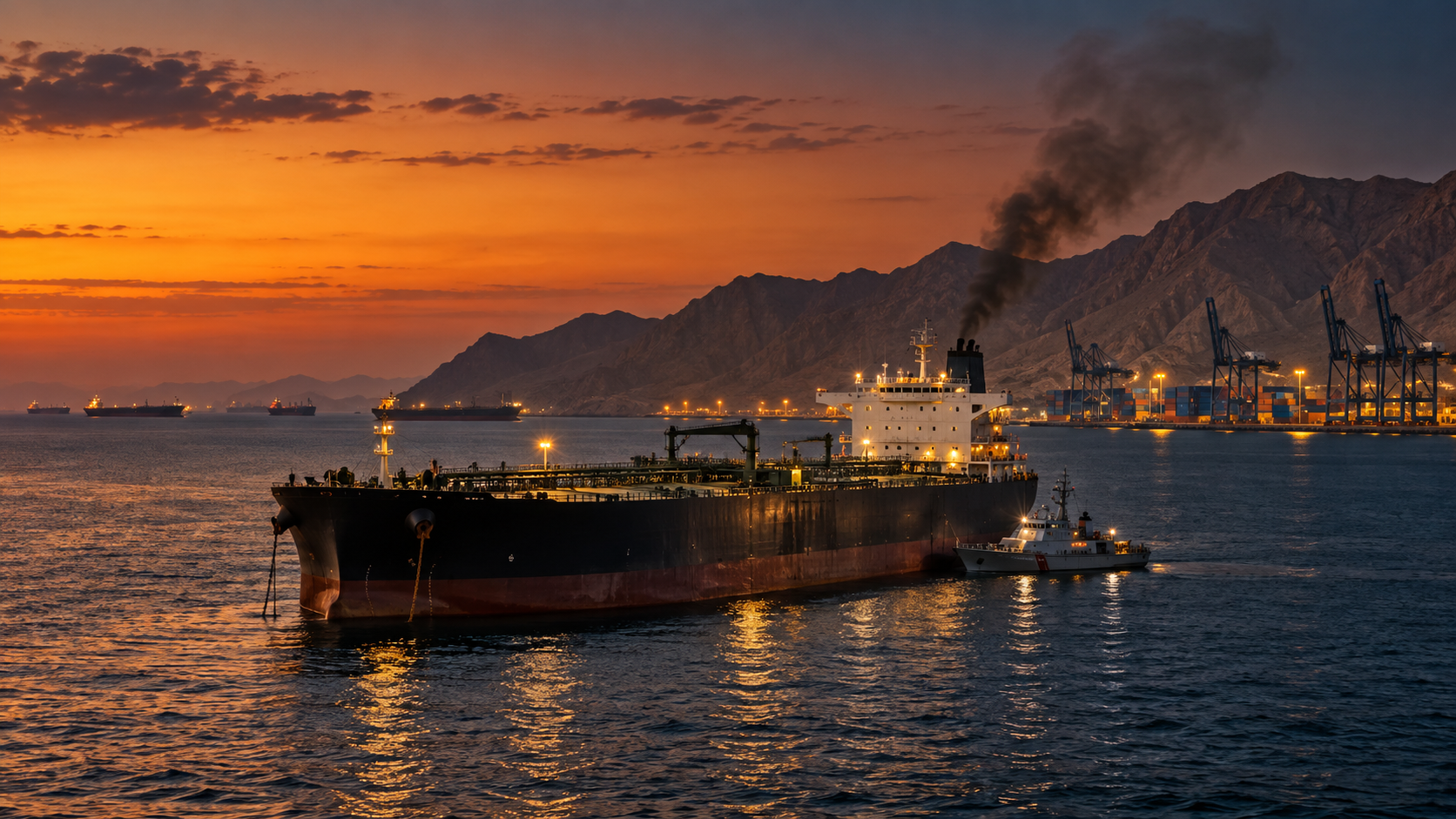
For six months, UAE cargo has survived the Strait of Hormuz closure by going around it. There were two ways around: the Saudi land corridor from the Red Sea, and the UAE east coast ports on the Gulf of Oman. In the space of one week in September 2026, both Hormuz bypass routes were hit.
On 10 and 11 September, drones launched from Iraqi territory struck Saudi Arabia’s East–West crude pipeline in the Riyadh and Medina regions. Saudi Arabia shut the pipeline down. On 13 September, the tanker El Gaia — already hit once in August — was struck a second time by an Iranian drone while anchored off the coast of Oman, and was towed into an Omani port with one crew member missing. On the same day, eight ships transited Hormuz. The pre-crisis norm was around eighty-five.
This is not a post about oil. It is about what those two attacks mean for anyone with a container booked into or out of the UAE right now, because the container workarounds run through exactly the same geography. The Jeddah land bridge crosses the Riyadh corridor the drones reached. The east coast ports sit on the Omani coastline where the El Gaia was burning.
Here is what has actually changed, what has not, and what we are doing on live bookings this week.
🚨 Cargo booked on a Hormuz bypass this month?
Send us the booking. We will tell you honestly whether the routing still holds this week, what the war-risk position is on that leg, and what the fallback looks like — before the vessel sails, not after.
What this update covers
- What happened in the week of 10–16 September
- Why the pipeline strike matters for containers, not just oil
- Why the Oman attack matters for the east coast ports
- Every Hormuz bypass route — status right now
- What this does to freight rates and surcharges
- Seven moves we are making on live bookings
- Hormuz bypass FAQs
What Happened in the Week of 10–16 September
| Date | Event | Which Hormuz bypass it touches |
|---|---|---|
| 10–11 Sept | Drones from Iraq strike the Saudi East–West pipeline in the Riyadh and Medina regions. Fires, damage, pipeline shut as a precaution. | Saudi corridor — the same Riyadh axis the Jeddah container land bridge uses. |
| 13 Sept | Tanker El Gaia hit by an Iranian drone while at anchor off Oman. Second strike on the same vessel. Towed to an Omani port; 13 crew rescued, one missing. | East coast — the Gulf of Oman side where Fujairah, Khor Fakkan and Kalba sit. |
| 13 Sept | A seafarer killed aboard an Iranian vessel off Qeshm Island. | Strait itself — confirms it remains an active conflict zone. |
| 13 Sept | Eight vessels transit the strait. Normal daily count is roughly 85. | Direct routing — still effectively closed, day 200+. |
None of these events on its own closes a container route. Together they change the risk picture on every Hormuz bypass at the same time, which is the part that has not been widely understood yet.
Why the Pipeline Strike Matters for Containers, Not Just Oil
The East–West pipeline is an oil asset. It moved around five million barrels a day from the Gulf coast to Yanbu on the Red Sea, letting Saudi crude leave without touching Hormuz. Shutting it is a large energy story. That is not why it matters here.
It matters because of geography. Since spring, MSC and Maersk have been running a container land bridge across Saudi Arabia: vessels discharge at Jeddah or King Abdullah Port on the Red Sea, and boxes are trucked roughly 1,300 kilometres to Dammam on the Gulf coast — via Riyadh. That corridor is the container industry’s Saudi Hormuz bypass, and it has been carrying meaningful UAE-bound volume.
The drones that hit the pipeline reached the Riyadh region. The land bridge trucks drive through the Riyadh region. Nobody has attacked a container truck, and there is no indication that is the intent. But the assumption underneath the Saudi land bridge — that the interior of the kingdom was outside the conflict’s reach — was tested on 11 September and did not hold.
Two practical consequences for anyone using this Hormuz bypass:
- Insurance on the road leg gets re-priced. Cargo insurers and hauliers price the corridor on perceived risk. A drone strike 100 kilometres from the route is a different risk picture from one 1,000 kilometres away.
- Jeddah was already congested. Several carriers had begun limiting or suspending land-bridge deliveries because of queue times at Jeddah before this happened. The pipeline strike adds a security question on top of a capacity problem.
Why the Oman Attack Matters for the East Coast Ports
Two weeks ago we published a guide to the UAE east coast ports — Khor Fakkan, Fujairah and Kalba — explaining why they had become the country’s primary Hormuz bypass. The logic was simple: they sit on the Gulf of Oman, on the open-sea side of the strait, so a vessel calling there never enters the chokepoint.
That logic is still correct, and the east coast remains the strongest Hormuz bypass for containers. What the El Gaia attack changed is the question of how far the conflict reaches beyond the strait.
The El Gaia was not transiting Hormuz. It was anchored off the coast of Oman when a drone hit it. Iran’s Revolutionary Guard said the vessel struck a mine; US Central Command said it was a drone strike and rejected the mine account. Either way, a commercial vessel at anchor on the Gulf of Oman side was hit, which is the same body of water the east coast ports open onto.
What this does and does not mean:
- It does not mean Fujairah or Khor Fakkan are closed. Both were operating at the time of writing, with carrier calls continuing.
- It does mean war-risk underwriters are now looking at the Gulf of Oman anchorages. Pre-war, a $100 million tanker carried a war-risk premium of around $250,000. In the Hormuz zone that figure has been running at $3 million to $10 million. The question every insurer is asking this week is where the zone boundary now sits — and Fujairah anchorage is inside the area they are looking at.
- It means the “safe side” is now a relative term. The east coast remains dramatically safer than a Hormuz transit. It is no longer a place the conflict cannot touch.
For shippers, the operational consequence is that an east coast booking now needs the same discipline as any other Hormuz bypass: confirm the discharge port in writing, ask what the war-risk surcharge is on that specific call, and know the fallback.
💡 Not sure which Hormuz bypass your cargo is actually on?
A booking confirmation that says “UAE” is not a routing. Send it to us and we will tell you the discharge port, the inland leg, and the risk position on each — in plain language.
Every Hormuz Bypass Route — Status Right Now
| Route | Status, mid-September | What changed this week |
|---|---|---|
| Direct via Hormuz | Effectively closed. 8 transits on 13 Sept. Maersk bookings suspended. Mainstream owners absent. | Nothing improved. Qeshm incident confirms active risk. |
| UAE east coast (Khor Fakkan, Fujairah, Kalba) | Operating. Khor Fakkan congested. Still the primary container Hormuz bypass for UAE cargo. | Drone strike on a vessel at anchor off Oman. War-risk zone boundary under review. |
| Saudi land bridge (Jeddah → Riyadh → Dammam) | Running for Saudi-destined cargo. Jeddah congested; some carriers limiting upper-Gulf deliveries. | Drones reached the Riyadh corridor. Road-leg risk and insurance being re-priced. |
| Oman ports (Sohar, Salalah + road) | Operating. Carriers evaluating as overflow for Khor Fakkan congestion. Kalba corridor links to UAE. | Same Gulf of Oman exposure as the east coast. Salalah is the furthest from the strait. |
The honest summary: every Hormuz bypass still works, and every Hormuz bypass now carries a risk premium it did not carry two weeks ago. The routing decision has moved from “which one is open” to “which one is priced correctly for my cargo and my deadline”.
What This Does to Freight Rates and Surcharges
Three things move on every Hormuz bypass, in this order:
- Bunker fuel. The pipeline closure took Saudi export capacity off the market and crude moved on the news. Bunker surcharges follow crude with a lag of days to a couple of weeks. Expect the emergency fuel component of your all-in rate to move before the base rate does.
- War-risk surcharges on the east coast. Where these were minimal or absent on Fujairah and Khor Fakkan calls, expect carriers to introduce or widen them if underwriters extend the listed area. This is the single line on the quote to watch.
- Road-leg pricing. Trucking from Khor Fakkan to Jebel Ali was already running around AED 4,500 per 20ft because of congestion. The Saudi road leg from Jeddah will carry a security element on top of its existing queue premium.
What has not changed: base ocean freight from Asia to the east coast remains well below any all-in figure for a Gulf call. The Hormuz bypass is still cheaper than forcing the strait. It is simply no longer as cheap as it was in August, and the gap between a quote issued last week and a booking made this week can be real money.
Seven Moves We Are Making on Live Bookings
- Re-confirming every discharge port in writing. Carrier schedules on the east coast are changing week to week. A booking that says “UAE” is not a routing. We ask for the port name and the ETA on paper.
- Itemising war-risk on the quote. One blended all-in number hides whether a war-risk component was added to the east coast leg. We want it as a separate line so the customer can see what moved.
- Splitting the inland leg from the ocean leg. For Saudi-destined cargo we are pricing the Jeddah road leg as its own contract with its own insurance, not as a footnote on the ocean rate.
- Holding a named fallback port on every file. If Khor Fakkan omits, the file already says Fujairah, Kalba or Sohar, with the cost difference pre-agreed.
- Booking trucks before the box is released. On both the east coast and the Saudi corridor, transport capacity is the constraint. Positioning trucks after clearance is how boxes sit.
- Shortening quote validity. Where we would normally hold a rate for two to three weeks, on Hormuz bypass routings we are holding for seven days. That is not to squeeze anyone; it is because the inputs are moving that fast.
- Telling customers when to wait. For non-urgent, low-value, high-volume cargo, the honest advice this week is sometimes to hold a fortnight and see where the war-risk zone settles. A forwarder who only ever says “book now” is not advising you.
Hormuz Bypass FAQs
Is the Strait of Hormuz open right now?
Effectively no. Eight vessels transited on 13 September against a normal daily count of around 85. The strait has been contested since late February 2026, briefly reopened in June, and returned to effective closure in July. Mainstream carriers have bookings suspended.
Are Fujairah and Khor Fakkan still safe to ship through?
They are operating and remain the primary Hormuz bypass for UAE container cargo. The El Gaia strike off Oman on 13 September means the Gulf of Oman is no longer outside the conflict’s reach, and war-risk underwriters are reviewing the zone boundary. Ship through them — but confirm the port, itemise the war-risk, and hold a fallback.
Is the Saudi land bridge still running?
Yes, for cargo destined to Saudi Arabia via Jeddah and King Abdullah Port. Jeddah was already congested, and the 11 September drone strikes reached the Riyadh corridor the land bridge uses. Expect the road leg to be re-priced and some carriers to keep limiting upper-Gulf deliveries by this route.
Which Hormuz bypass is cheapest for UAE-bound containers?
For most standard containers from Asia, the east coast — Khor Fakkan for boxes, Fujairah for mixed cargo — still lands cheaper than any Gulf call, even after the road leg to Dubai. The exception is low-value, high-volume freight where AED 4,500 per box of trucking is a large share of landed cost. Price it per shipment.
Will war-risk surcharges now apply to east coast calls?
That is the open question this week. Where carriers had minimal or no war-risk component on Fujairah and Khor Fakkan calls, an extension of the listed area by underwriters would change that. Ask for the surcharge itemised on any quote issued after 13 September.
Should I delay shipping until this settles?
For urgent or high-value cargo, no — route through the east coast with a confirmed port and a fallback. For non-urgent, low-margin volume, a short hold to see where insurance settles can be the right call. There is no single answer; it depends on what the cargo is worth against what a two-week delay costs you.
How quickly do these routings change?
Weekly, sometimes faster. On every Hormuz bypass, carrier operational updates are now being issued every few days. A routing that was correct on a Monday quote can be wrong by the Friday booking. That is why quote validity on Hormuz bypass lanes has shortened across the market.
We have been on the Hormuz bypass since February.
Vortex Shipping operates vessels, supplies containers, clears customs through our own desk and runs our own road transport across the UAE. We have routed cargo through every workaround this year — and we will tell you honestly which one holds this week, including when the answer is to wait.
Check My Routing → WhatsApp Us
Or call us direct: +971 54 231 0203 · +971 50 952 9413
Email: manager@vortexshipping.ae · Office 1914, The Binary by Omniyat, Business Bay, Dubai
Related Guides
- UAE East Coast Ports: The 3 Gateways Still Open While Hormuz Stays Shut
- Strait of Hormuz Closed Again: UAE Freight Rates & 7 Moves to Protect Your Cargo
- UAE Shipping Crisis 2026: Rates, Routes & 7 Fixes
- Dubai to Saudi Arabia: Road vs Sea Freight
- Land Transport in Dubai: Our Own Fleet
- Sea Freight Services in Dubai
Sources
- Al Jazeera — Saudi Arabia shuts critical oil pipeline after drone attack
- CNBC — Saudi Arabia shut down East-West crude oil pipeline after drone attacks from Iraq
- The Sunday Guardian — Oil tanker hit off Oman being towed back to Omani port
- The National — War-risk shipping premiums surge as attacks intensify
- Trans.info — MSC turns to Saudi landbridge as Hormuz disruption pushes containers onto trucks
- Maersk — Middle East Operational Update 45, 9 September 2026
- Straits.live — Strait of Hormuz live transit tracker
Route status, incident details and rate observations reflect reporting available as of 18 September 2026. The war-risk position on the Gulf of Oman is under active review by underwriters and may change within days — confirm the surcharge and the discharge port with us before you book.