
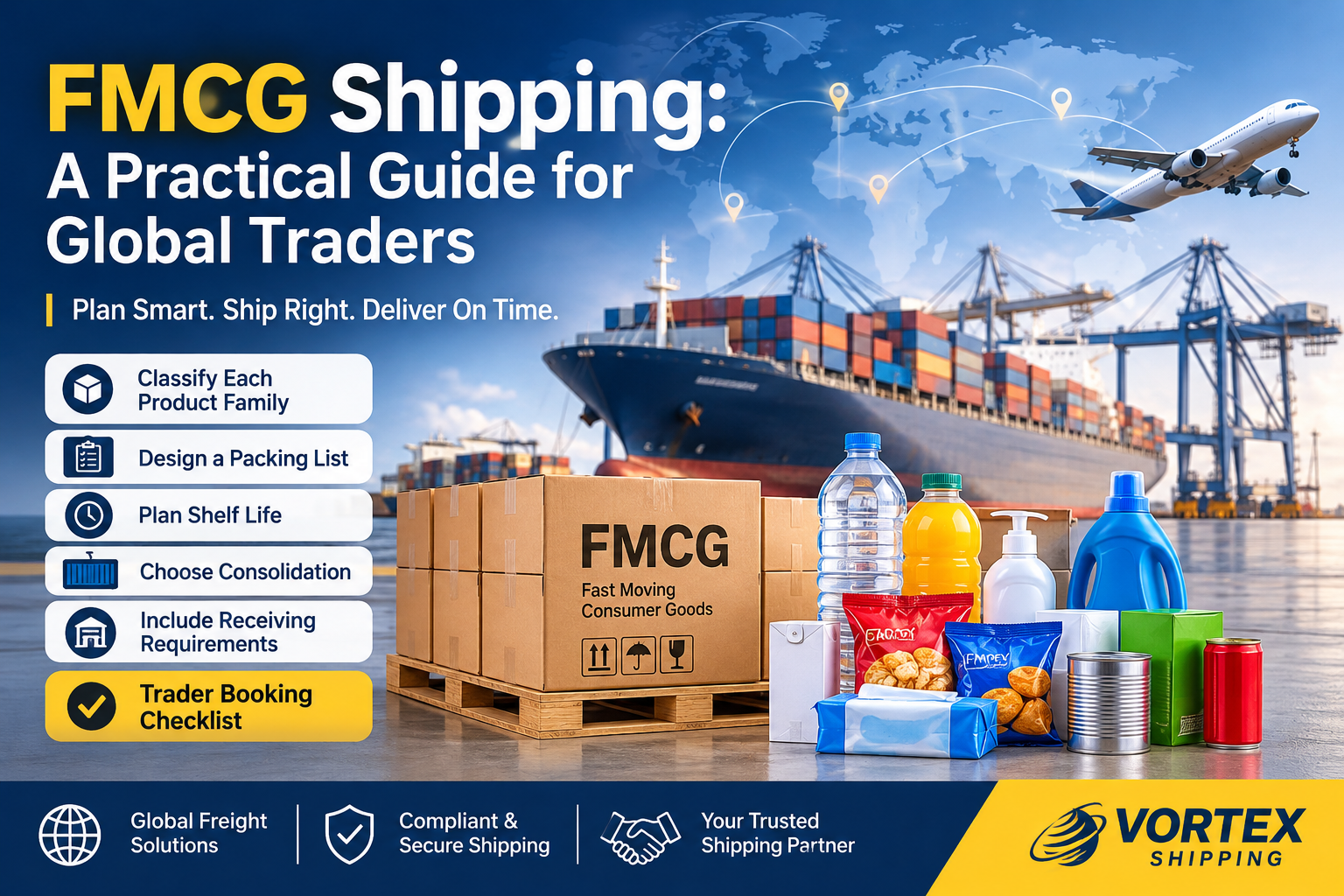
FMCG shipping across international markets is a coordination task as much as a transport task. A mixed container can hold many products, suppliers and batches, yet the receiving warehouse needs a clear answer to a simple question: what has arrived, and where should it go? Good shipment records reduce the time spent opening cartons, resolving shortages and correcting delivery appointments.
This guide covers ordinary packaged consumer goods. Food, cosmetics, aerosols, batteries and other regulated products need their own product-level review within the wider order.
FMCG shipping: classify each product family
“FMCG” is a business category, not one customs classification. Prepare a SKU register with product description, brand, origin, quantity, value and proposed classification for broker review. Separate food from personal-care products, household items and any dangerous goods.
As a UAE example, Dubai Customs identifies foodstuffs and personal-care/cosmetic products among categories controlled by relevant authorities. Consult its restricted-goods guidance and confirm the current process for each item with the authority in the actual destination country. An approved shampoo does not automatically establish approval for an unrelated cleaning product.
Design a packing list the warehouse can use
Show carton count, units per carton, pallet number, gross weight and dimensions. Where applicable, record batch, manufacture and expiry details. Include a pallet-level map for mixed loads so the receiving team can locate urgent or short-dated stock without unloading blindly.
Agree barcode and label requirements before the supplier prints carton labels. A mismatch between the supplier’s code and the buyer’s receiving system can cause delays even when the goods themselves are correct. Keep packing-list versions controlled when quantities change.
Plan shelf life backwards from delivery
Ask the buyer for minimum remaining shelf-life requirements at receipt. Work back through inland delivery, clearance, vessel schedule and production readiness. Distinguish a buyer’s commercial acceptance condition from a legal product requirement; both may matter, but they are not the same rule.
For repeat orders, maintain a replenishment calendar with realistic buffers. Do not rely on one optimistic transit estimate for every sailing. Promotions, receiving appointments and holiday closures can make a small delay more commercially important than the freight-rate difference.
Choose consolidation with compatibility in mind
LCL can be useful for smaller orders, while FCL may offer more control over the load. Compare the number of handling points, product compatibility, total destination charges and delivery urgency. Goods vulnerable to odour, leakage or crushing should not be combined casually with other products.
Ask whether the shipment needs ambient, protected or temperature-controlled handling. “Dry cargo” does not mean every product is indifferent to heat. The manufacturer should define acceptable storage and transport conditions. See our FCL versus LCL guide for the transport comparison.
Include receiving requirements in the quote
- Warehouse address and appointment process.
- Pallet type, height limits and barcode requirements.
- Tail-lift, forklift or loading-bay availability.
- Split delivery destinations and any time-window restrictions.
- Responsibility for unloading, shortages and rejected cartons.
Request separate figures for freight, clearance and final distribution. Discuss warehousing requirements before booking if the buyer cannot receive the full order immediately.
Fmcg shipping: trader booking checklist
Use this checklist with the supplier and receiving importer before requesting a firm booking. The transport proposal should identify who supplies each item and which details remain subject to confirmation.
| Planning item | Information to prepare | Why it matters |
|---|---|---|
| SKU schedule | Item description, carton count, packed size and gross weight for each line. | Mixed retail products need a clear packing list that the receiver can reconcile. |
| Product compatibility | Identify food, cosmetics, aerosols, cleaning products and other special categories separately. | A general FMCG label does not establish that products can share a shipment or storage environment. |
| Shelf-life requirements | Batch dates, minimum remaining shelf life and receiving conditions agreed with the buyer. | A delivery that arrives on time can still fail the buyer’s acceptance criteria. |
| Warehouse delivery | Pallet labels, carton references, appointment rules and unloading scope. | Retail or distributor warehouses may have receiving procedures that need advance preparation. |
Keep one agreed shipment brief for the supplier, freight desk and receiver. If a quantity, packing method or receiving location changes, circulate the revised brief before equipment or collection is confirmed. Retain the accepted quotation and its exclusions alongside the final packing list so that responsibility for each service remains clear.
Have a shipment ready to discuss?
Send a SKU-level packing list with carton or pallet dimensions, gross weight, batch dates where relevant and the buyer’s receiving requirements. Identify products needing a separate regulatory or dangerous-goods review before a combined shipment is priced.
Need a rate for this lane?
Message our Dubai desk on WhatsApp with the route and the cargo. We reply the same working day — and we will say plainly if the lane is not workable right now.
Frequently asked questions
Can every FMCG item share one declaration?
The broker needs a product-level review. Different classifications and approvals may apply within one commercial shipment.
Is a supplier invoice enough for receiving?
It rarely provides all operational detail. A clear SKU and pallet-level packing list makes counting and exception handling easier.
How do I request a quotation?
Send the SKU list, packing details, product conditions, ready date and receiving instructions through our contact page. Identify regulated items at the start.
Confirm the origin, destination and delivery scope
For FMCG shipping, give both the loading location and the final receiving address. Compare direct and connecting options only after the cargo and route have been accepted. An estimated main-carriage transit does not include every collection, border, inspection or delivery step.
Explore the Vortex Shipping global network and request a route-specific assessment. Dubai is a relevant hub for some movements; the enquiry should identify the actual origin and destination rather than assume every shipment starts or ends in the UAE.
Request a fmcg freight assessment
Send a SKU-level packing list with carton or pallet dimensions, gross weight, batch dates where relevant and the buyer’s receiving requirements. Identify products needing a separate regulatory or dangerous-goods review before a combined shipment is priced.
Editorial review: 19 October 2026. Check current authority guidance and shipment-specific acceptance before making commercial commitments.