
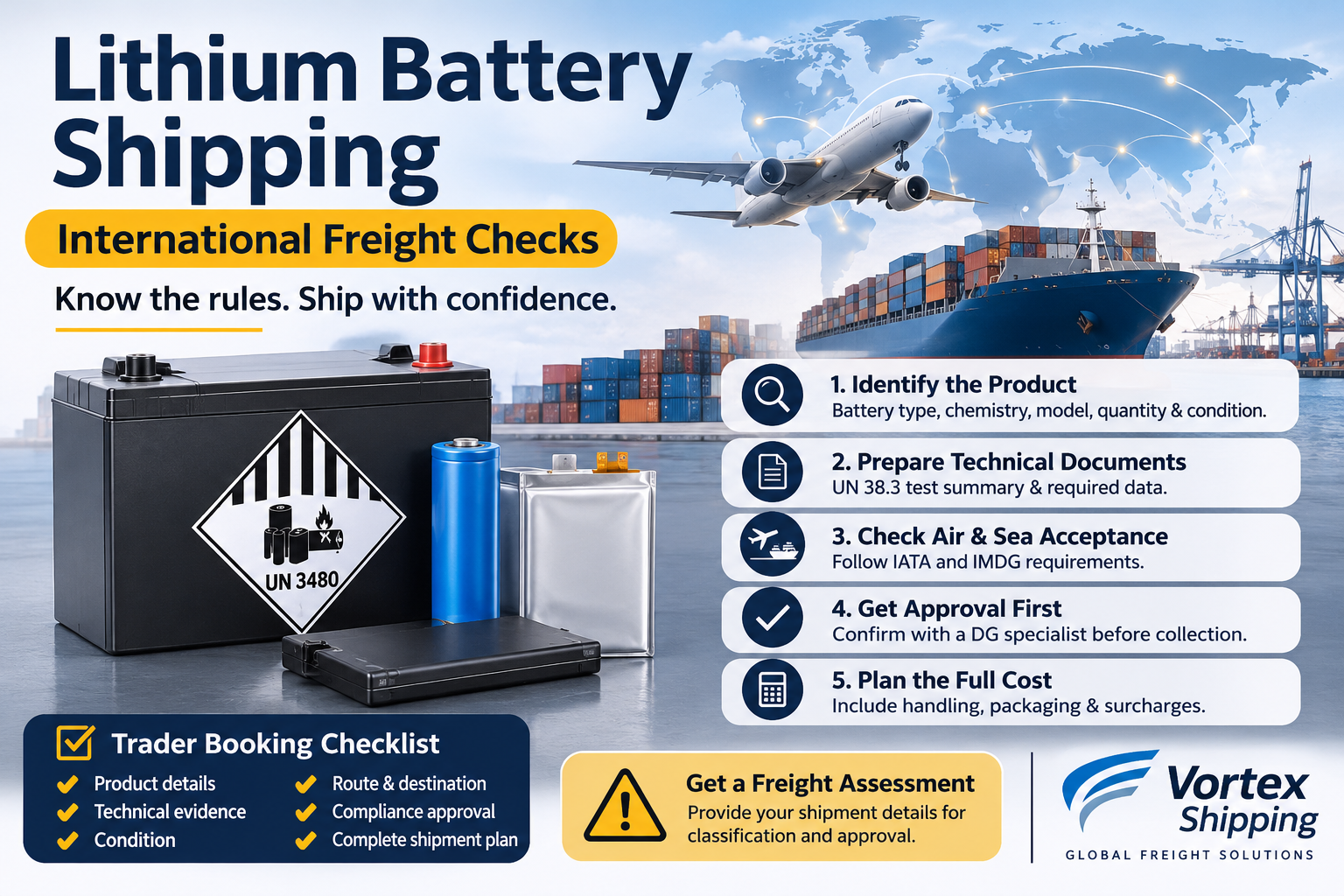
Lithium battery shipping across international borders requires a product-specific dangerous-goods review before a freight booking can be confirmed. A battery sold for solar storage, a replacement vehicle battery and a small battery installed in equipment may have different transport conditions. Commercial names such as “lithium” or “LFP” are not enough to decide how a shipment can move.
Use this guide to prepare a document pack for a qualified dangerous-goods specialist. It is not a substitute for classification, packing instructions or current carrier approval.
Lithium battery shipping: identify what is actually being shipped
Separate standalone batteries, batteries packed with equipment and batteries contained in equipment. Record the chemistry, manufacturer, model, quantity, watt-hour rating where relevant, gross weight and whether units are new, used, damaged, defective or recalled.
Do not assume that a chemistry marketed as safer is exempt from transport regulation. Similarly, equipment containing a battery should not be declared as battery-free merely because the battery is hidden inside its housing. Give the specialist the full product configuration.
Prepare the technical documents
IATA explains that manufacturers and subsequent distributors must make the relevant UN 38.3 test summary available for applicable lithium cells and batteries. See its battery shipping guidance.
Ask the manufacturer for a model-matched test summary and the other technical information requested by the specialist. An SDS alone is not evidence that all transport testing and packing requirements have been met. Check that model identifiers agree across the invoice, datasheet and test documentation.
Air and sea acceptance are separate reviews
Air transport conditions depend on classification, packing configuration and applicable operator restrictions. Do not copy passenger baggage guidance into a commercial cargo booking. The current IATA dangerous-goods resources should be checked by the person preparing the shipment.
For sea freight, the IMO states that IMDG Amendment 42-24 became mandatory on 1 January 2026. The official IMDG page identifies the applicable edition. A compliant classification still does not guarantee that a chosen carrier, vessel or route will accept the cargo.
Get approval before collection
Send the technical file before arranging trucking to the port or airport. Obtain written confirmation of the accepted product, route, packing arrangement and required documents. Changes in quantity, model or condition must be reviewed instead of being added to an existing approval informally.
Damaged, defective, recalled or waste batteries require specialist assessment. Keep them outside a routine new-product booking unless the responsible specialist and carrier have explicitly approved the shipment. This avoids treating a materially different risk as an ordinary commercial variation.
Budget for the complete movement
Ask the quotation to identify document preparation, compliant packaging, handling, carrier surcharges, origin transport and destination arrangements. Confirm whether specialist storage or inspection costs are included. A basic freight rate for general cargo is not a meaningful comparison.
Allow time for technical review before promising dispatch to the buyer. Consider the full approval and delivery process, not only the estimated sailing or flight duration. Our DG cargo service page explains how to begin an assessment.
Lithium battery shipping: trader booking checklist
Use this checklist with the supplier and receiving importer before requesting a firm booking. The transport proposal should identify who supplies each item and which details remain subject to confirmation.
| Planning item | Information to prepare | Why it matters |
|---|---|---|
| Product identity | Cell or battery model, chemistry and whether shipped alone, with equipment or installed in equipment. | These are different transport situations and must be reviewed against the applicable rules. |
| Technical evidence | Manufacturer’s current product data and the relevant test-summary information. | The review must relate to the battery being shipped, not a similar catalogue item. |
| Condition | New, used, damaged, defective or recalled status; disclose any prototype or unusual product condition. | Condition affects the acceptance assessment and cannot be inferred from an invoice description. |
| Route acceptance | Origin, transit points, destination and preferred mode. | Acceptance must cover the complete proposed movement before dispatch is arranged. |
Keep one agreed shipment brief for the supplier, freight desk and receiver. If a quantity, packing method or receiving location changes, circulate the revised brief before equipment or collection is confirmed. Retain the accepted quotation and its exclusions alongside the final packing list so that responsibility for each service remains clear.
Have a shipment ready to discuss?
Provide the exact manufacturer and model, technical data, shipment configuration, package count, gross weight, route and product condition. Have a qualified dangerous-goods specialist confirm classification and shipment requirements; do not use this article as a packing instruction.
Questions to resolve before booking
Is the SDS sufficient?
Usually it is only one part of the technical file. The specialist must identify the documentation, testing evidence and declarations required for the specific shipment.
Can batteries move with solar modules?
Potentially, subject to a separate assessment of the batteries, packing and proposed transport. Do not classify the entire load simply as solar panels.
What information should I submit?
Send model details, chemistry, configuration, condition, quantities, weights, technical documents and route through our enquiry form. Acceptance must be confirmed before dispatch.
Confirm the origin, destination and delivery scope
For lithium battery shipping, give both the loading location and the final receiving address. Compare direct and connecting options only after the cargo and route have been accepted. An estimated main-carriage transit does not include every collection, border, inspection or delivery step.
Explore the Vortex Shipping global network and request a route-specific assessment. Dubai is a relevant hub for some movements; the enquiry should identify the actual origin and destination rather than assume every shipment starts or ends in the UAE.
Request a lithium batteries freight assessment
Provide the exact manufacturer and model, technical data, shipment configuration, package count, gross weight, route and product condition. Have a qualified dangerous-goods specialist confirm classification and shipment requirements; do not use this article as a packing instruction.
Editorial review: 19 October 2026. Check current authority guidance and shipment-specific acceptance before making commercial commitments.
Need a rate for this lane?
Message our Dubai desk on WhatsApp with the route and the cargo. We reply the same working day — and we will say plainly if the lane is not workable right now.