
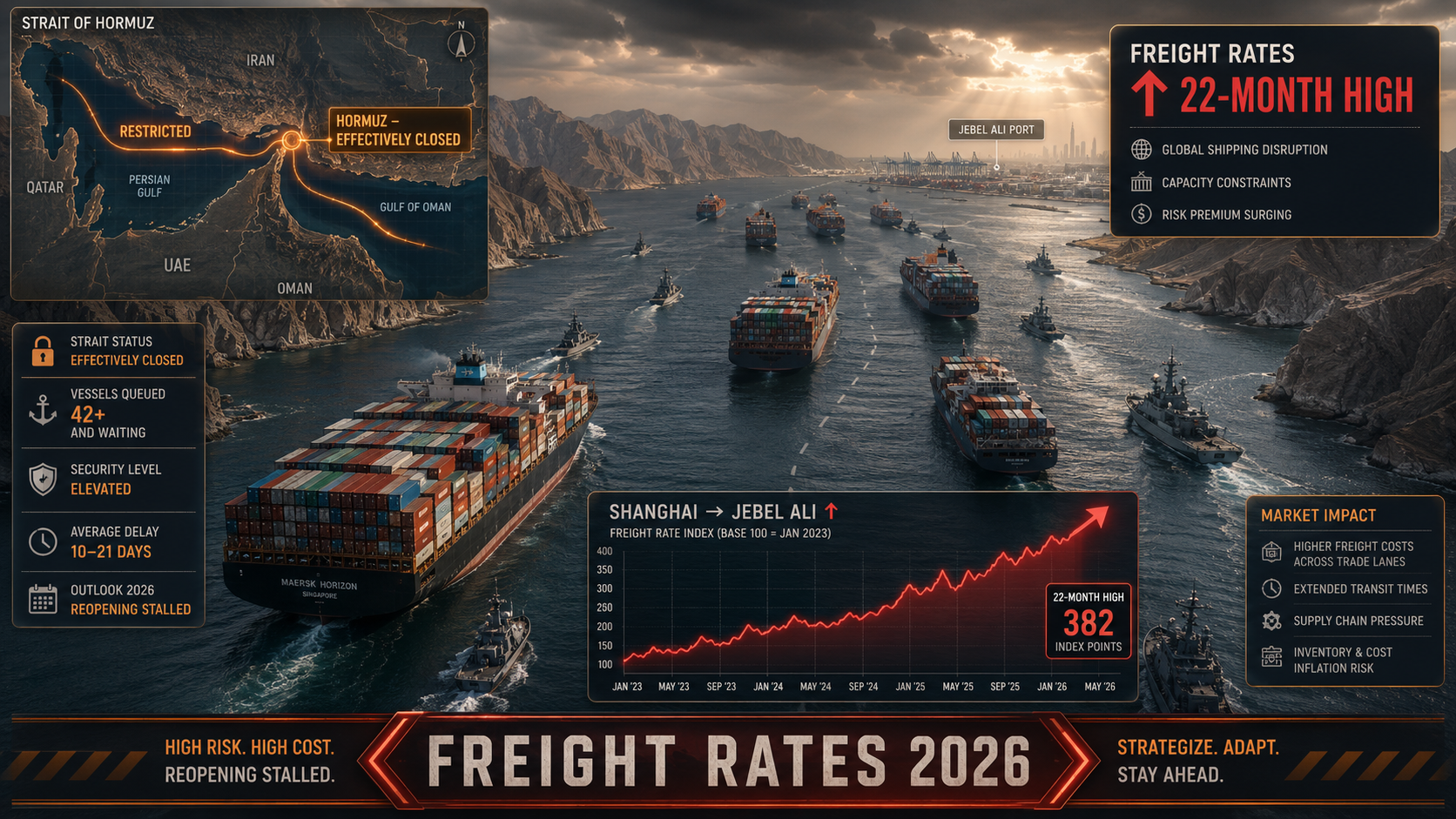
Strait of Hormuz freight rates 2026 are the number one concern for every UAE importer and exporter right now — and the situation has shifted fast. In mid-June, a US–Iran framework deal sparked hopes that the strait would reopen and rates would fall. But a fresh escalation in late June has stalled that recovery, the waterway remains effectively closed, and container costs have climbed to a near two-year high. If you move cargo through the Gulf, this is the update you need before you book your next shipment.
This guide from Vortex Shipping gives you the verified, up-to-date picture on Strait of Hormuz freight rates 2026 — what changed, where prices actually stand, and the exact steps smart UAE businesses are taking to protect their margins this month.
Catch up first: Read our UAE Shipping Crisis 2026 guide for the full background, and our Strait of Hormuz Reopening 2026 guide for how the deal first raised hopes. This post is the latest update on top of both.
Strait of Hormuz Freight Rates 2026: The Latest Situation
The Strait of Hormuz has been functionally closed to commercial shipping since late February 2026. After the US–Iran framework agreement in mid-June, traffic briefly ticked up and the IMO launched an evacuation plan to bring out stranded seafarers, raising expectations of a phased reopening. Traffic did show early signs of increasing on 16–17 June, but mostly outbound vessels — not carriers re-establishing regular Gulf services.
Then the recovery stalled. A late-June flare-up — including an attack on a cargo ship and renewed military strikes — pushed the maritime threat level back up and sent carriers back into wait-and-see mode. As a result, commercial transits are still running at roughly 5% of normal volume (about five vessels a day versus a pre-crisis average near 93). In short: the deal is on paper, but Strait of Hormuz freight rates 2026 are not yet behaving like a market that has reopened.
Why Freight Rates Are Still High — Not Falling
Here is the part that surprises most shippers. Even with oil prices easing back toward pre-war levels, container freight rates have actually risen to a 22-month high. The Drewry World Container Index recently climbed past $4,166 per 40-foot container, driven largely by a trans-Pacific shipping rush ahead of July fuel surcharges and possible tariff changes — not by Hormuz easing.
For Gulf-linked lanes specifically, the pressure is even sharper. Shanghai-to-Jebel Ali container rates have roughly quadrupled since the crisis began, from under $2,000 to above $8,000 per container at the peak. Several factors are keeping Strait of Hormuz freight rates 2026 elevated at once:
- War-risk insurance surcharges for tankers and Gulf-bound cargo are priced at many times their pre-crisis level, and some insurers have pulled cover entirely.
- Capacity is down sharply — available space on Gulf services is running well below pre-crisis levels, with only gradual recovery expected over the summer.
- Fuel (bunker) surcharges and general rate increases stacked on top of base rates across most lanes.
- Port congestion at alternative hubs — Khorfakkan, Sohar, Fujairah, Salalah and Jeddah — adding delays and trucking costs.
How Long Until Strait of Hormuz Freight Rates Normalise?
Don’t expect an overnight reset. Major forwarders including DHL Global Forwarding have told customers that shipping through the Strait of Hormuz could take roughly four to six months to fully normalise, even once a deal holds. And as carriers have warned, the end of the conflict is not the end of the disruption — when services restart, hundreds of ships will rush to call at Gulf ports at once, creating a fresh wave of congestion and rate volatility.
The realistic outlook for Strait of Hormuz freight rates 2026 is a slow, uneven recovery: capacity rebuilding through the summer, war-risk premiums easing only as the ceasefire proves durable, and rates staying firm with frequent revisions in the near term. Businesses that plan for volatility — rather than betting on an instant drop — will come out ahead.
What Smart UAE Businesses Should Do Right Now
With Strait of Hormuz freight rates 2026 still elevated and unpredictable, here is the practical playbook experienced importers and exporters are following this month:
- Get a live quote before you commit. Published averages are out of date within days right now. Lock your actual rate and space with a forwarder who has real-time carrier access. Request a current quote here.
- Book early and build a buffer. With capacity tight and congestion likely as services restart, add lead time to your delivery promises rather than assuming normal transit.
- Use a blended routing strategy. Combine direct Gulf services where reliable with feeder and bonded-trucking fallbacks via Khorfakkan, Sohar and Fujairah. Our feeder operator guide explains how this works.
- Review your war-risk and cargo insurance. Make sure your cover matches current routing, and don’t keep paying peak-crisis premiums once they start to ease.
- Control the costs you can. Optimise container utilisation (FCL vs LCL), consolidate shipments, and tighten customs documentation to avoid delay charges. See our guide to cutting shipping costs from Dubai.
- Work with a partner who tracks this daily. The single biggest advantage right now is current intelligence — knowing which carriers are accepting Gulf bookings today and at what rate.
Strait of Hormuz Freight Rates 2026 — Frequently Asked Questions
Is the Strait of Hormuz open again in 2026?
Not in practice. A US–Iran framework deal in mid-June raised hopes and some transits resumed, but a late-June escalation stalled the reopening. As of late June 2026 the strait remains effectively closed, with commercial traffic at roughly 5% of normal volume.
Are UAE freight rates going up or down?
Container freight rates have risen to a near two-year high, driven mainly by trans-Pacific peak-season demand and fuel surcharges rather than Hormuz easing. Gulf-linked lanes such as Shanghai-to-Jebel Ali have seen rates multiply several times over since the crisis began.
When will shipping through the Strait of Hormuz return to normal?
Major forwarders estimate full normalisation could take around four to six months even after a stable deal, because capacity, insurance and vessel repositioning all recover gradually. Expect firm, volatile rates in the near term.
How can I reduce my shipping costs during this period?
Get live quotes instead of relying on averages, book early, use blended routing through alternative UAE hubs, optimise container utilisation, and keep customs documentation tight. A Dubai-based forwarder can help you do all of this — contact our team for tailored advice.
Need a rate for this lane?
Message our Dubai desk on WhatsApp with the route and the cargo. We reply the same working day — and we will say plainly if the lane is not workable right now.
Sources & Further Reading
- Sourcing Journal — Container freight rates hit a 22-month high (Drewry WCI)
- Freightos — The Strait of Hormuz and the container market
- IndexBox — Strait of Hormuz traffic increases mid-June 2026
- IMO — Middle East / Strait of Hormuz guidance
Vortex Shipping: Your Real-Time Logistics Partner in the UAE
While Strait of Hormuz freight rates 2026 stay high and the reopening plays out in fits and starts, the businesses that win are the ones with current intelligence and flexible routing. Vortex Shipping is on the ground in Dubai with direct carrier relationships, live route and rate visibility, and the customs expertise to keep your cargo moving — by sea, air and road.
📞 Call us: +971 54 231 0203
🌐 Get your live shipping quote from Vortex Shipping →
Your cargo. Our expertise. Delivered worldwide — whatever the market does.